Seeing the light through the clouds
Rev. Sarah Kitch’s journey to Seaside

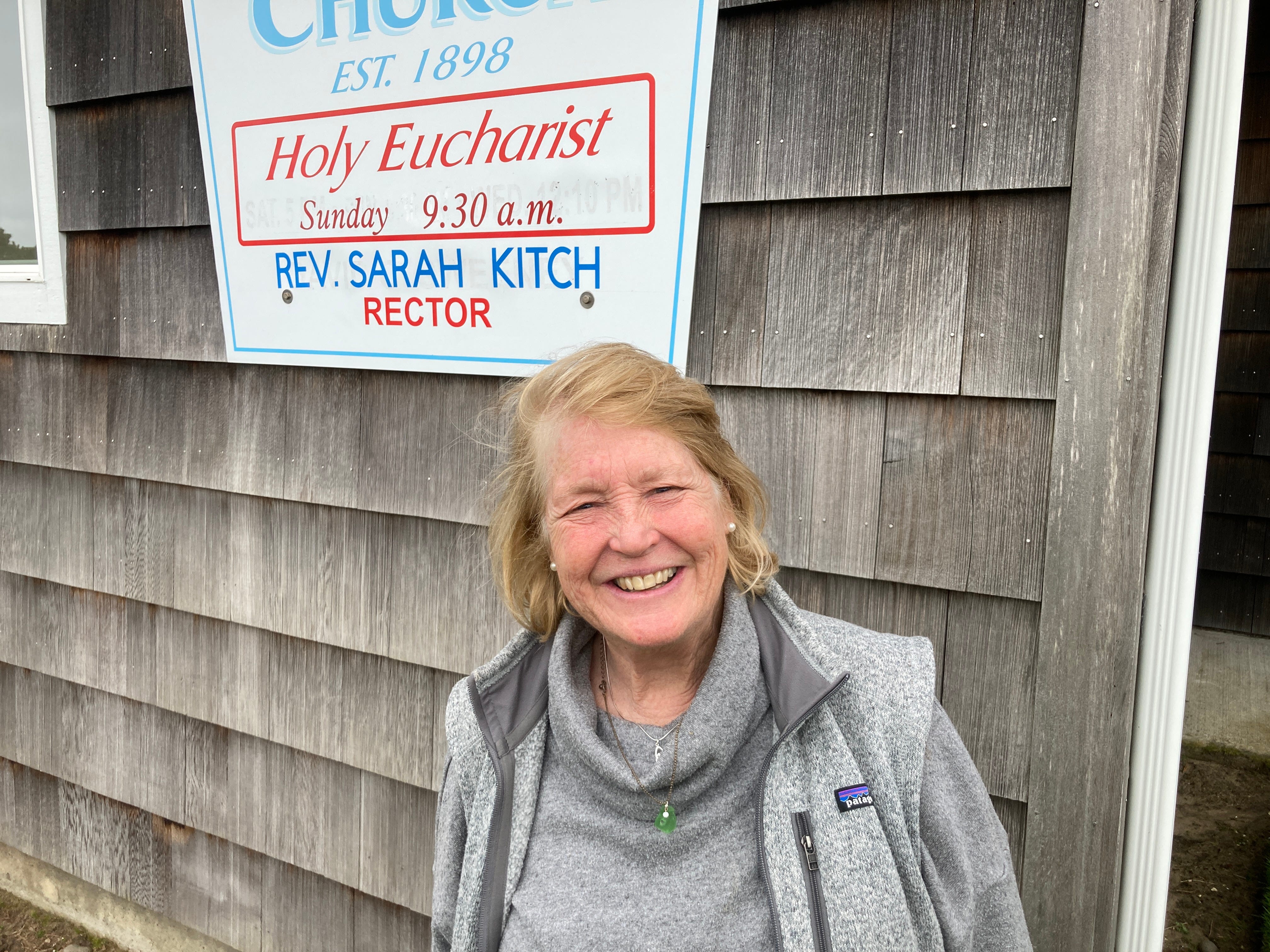
SEASIDE — For Rev. Sarah Kitch, the path to the pulpit at Calvary Episcopal Church didn’t start with a traditional calling. It began under the stage lights of Syracuse and the traveling vans of a global repertory theater company.
After a 33-year career in the performing arts — a life influenced by her father, legendary CBS producer Charles Underhill — Kitch found herself at a crossroads in 2010. When the “show closed” on her acting career, a mentor asked a simple question: “Have you ever thought about seminary?”
Now, less than a year into her tenure in Seaside, Kitch is using her theatrical background to “re-envision” what a church can be. In a town often divided by politics and the modern struggles of addiction, she is pitching a tent of “radical welcome,” focused on the divine core she believes exists in every neighbor.
Q: So Hi, Sarah. How long have you been in Seaside?
Kitch: It is less than a year now. I got here June 21.
Q: You have an interesting path here. You weren’t necessarily always a priest?
Kitch: No. I finished my career in theater in 2010.
Q: Do you call yourself a reverend or a priest?
Kitch: Yes, it is all the same. I have been a priest for 16 years.
Q: Tell me about your journey — your growing up journey, how you got into acting, and then how you transformed into the clergy.
Kitch: Well, the acting part was not hard. I grew up in New York, in Armonk. My mother was involved with radio soap operas right before the transition of radio to television. She was involved with a soap opera called “The Life of Helen Trent,” which was long running and very successful, and also “Abie’s Irish Rose.” That was just the world that I grew up in. My father, Charles Underhill, was involved with the early days of television. He was with CBS as a producer. He is known for bringing Walter Cronkite over to television. We lived in the country in Armonk, and that was really my growing up. I would go into New York all the time — to Rockefeller Center and to shows.
Q: Your dad commuted from White Plains?
Kitch: Yes, exactly. I was brought up on shows.
Q: So you were in an artistic, theatrical household. It was natural that you started acting.
Kitch: It absolutely was. When I graduated from high school, I ended up on Cape Cod, Massachusetts, and I was involved with community theater and summer stage. Then I went to Syracuse University and was involved with Syracuse stage.
Q: That is a great theater school. Did you seriously consider a life on the stage?
Kitch: Absolutely. At the time, my parents still had quite a few contacts in New York, and my sister actually went to work with “Electric Company” and also “Sesame Street.” But when I was at Syracuse University, I saw a repertory theater company in California. We were involved in the theater department to get a job, so I made an application and was accepted. I went out to California and stayed for 33 years.
Q: That must have been in the ’70s?
Kitch: I did that in ’76. It was a repertory theater company called Covenant Players. It was traveling and we had gigs all over the nation and internationally. At one time, there were over 500 of us in the company all over the world. We were doing it in different languages in a lot of different venues.
Q: What was the idea behind that group?
Kitch: It was the idea of using theater to leave questions in the audience. We worked on a thematic basis and worked with people on the needs of their community. We did a lot of work with the military regarding deployment and returning. We worked with chaplains on things that were relevant. We had a very prolific writer who could write to those specifics.
Q: So scripts were more “made to order”?
Kitch: Yes. The repertory was very large. We would take an issue and build a program for about an hour and a half. It would be different plays taking the issue from different points of view. We used a lot of humor to open up topics for discussion. We also did a lot of work in prisons as an objective tool for the choices that had been made.
Q: Was that what motivated you into divinity?
Kitch: No, not at all. Actually, the classic sentence is: “The show closed.” It was just over. I was at a crossroads because I was too young to retire yet I thought theater would be my life career. It was actually a priest at a church I was attending who proposed the question.
Q: What was the question?
Kitch: “Have you ever thought about seminary?” I said no. Part of it was because my experience with the church in this theater company had been so broad — we performed in churches from every end of the spectrum — that I had no confidence that a church could use my energy because my experience had been so vast.
Q: You thought you weren’t quite “parochial” enough.
Kitch: Yes, I was very broad-minded. I still am. But I was Episcopal all my life. It was a choice, because the Episcopal church is broad, inclusive, and welcoming.
Q: So your priest’s words resonated?
Kitch: I don’t know if it resonated so much as I didn’t have anything else I could do. I was 45. My husband was very supportive of me trying a new career. I went to a seminary that you could attend over the weekend while I was working at a private school as a chaplain and teacher. I did that for three years and walked out with a deaconal certificate. I thought the collar itself was a “ticket” to walk into places I wouldn’t be able to otherwise — like hospitals or social justice issues.
Q: As a reporter, I can relate. You were looking for a ticket to see how people act in real life.
Kitch: That is a good way to say that. But the end of the story is that the gentleman I was working with as a priest lost his eyesight. I became more involved in the church than was appropriate for a deacon. That is when the question opened up again that I should be a priest. I finished a year for a master’s in divinity and was ordained in 2015.
Q: Did you have a specialty? Or did you want to be a parish priest?
Kitch: I didn’t want to be a parish priest. Yet here I am. This wasn’t my intention, but it is probably why I know I am supposed to be here. I had an assignment in L.A. for 15 years as a school chaplain. I love working with kids and developing curriculum to expand their imagination. Because of the theater background, we were coming up with crazy things to talk about kindness, generosity, and character values.
Q: You strike me as a very positive person. What’s the secret?
Kitch: Pausing long enough to see the light through the clouds and the goodness that is present. Goodness is present — and sometimes we just have to wait a minute for it to come up. I believe love and goodness are present on a daily basis.
Q: That gets tested every day, especially in the current time.
Kitch: Sure it does. But I really do believe the goodness is there. I believe in the goodness of people. I believe divine love is always present and we reflect that in compassion and generosity. We see that often when there are tragedies or adversity; people come together and help each other on a sacrificial basis.
Q: So after 10 years in L.A., you developed the “chops” to be a parish priest. Did you find this job on the internet?
Kitch: There is a working dashboard. Seaside had a priest for 24 years, David Sweeney. For two and a half years after he retired, they didn’t have anybody. They were doing fine holding down the fort as a community, but it was not really forthcoming. On this dashboard, you get connected with the diocese. When I talked to the woman in charge, she mentioned one little church that hadn’t had anything coming in. The interview to apply for this was terrible because the Zoom connection kept going down, but in a short amount of time, we connected.
Q: What did they ask you?
Kitch: I think they asked about my vision for the church. For me, institutionalism needs to be re-envisioned. Some of the formative pillars are not relevant anymore and are not serving the people.
Q: Do you mean ritual, or something else?
Kitch: There’s always going to be a place for ritual. But if we don’t have a place that’s relevant for that content, something else has to be bubbled up. An institution will always preserve itself, but if the structure is not relevant to the people, you have to re-envision why we are gathering.
Q: In other words, not just going through the motions, but reimagining it for the current situation.
Kitch: Exactly. They were fairly forward-thinking. The church needs to be “porous” — outside the walls. I am very keen on getting into the community and having relationships. That is where jazz comes into it. I met the jazz community early on when I came to Seaside and thought, “This is awesome.” Having music and community events in a church space is not a new idea, but in Seaside it might be to a degree.
Q: But it seems like you’ve been met with positive energy.
Kitch: Very. People want to have a space that is resident of light, warmth, and even a sacred space.
Q: Seaside is diverse in terms of the types of people that come here. How do you unify so many different strands?
Kitch: I am not sure “unify” is the right word. The real work is the authentic welcome of diversity. We are gathered together as a diverse group of people, focusing on the goodness of the event. All are welcome — whether you understand the music or not. From that point of reference, what do you contribute out of your uniqueness? How can we develop that?
Q: Oregon has certain problems — high rates of sex offenders, drug abuse, and methamphetamine. In Seaside, there is a significant homeless and addict population. Do you feel it’s your mission to reach out to these folks?
Kitch: I think it needs to be organic. As the need is presented, we need to be responsive. Our awareness and participation in bringing what we can to those needs is part of it. Organically, it comes through relationships. As I get to know people in the unhoused population, I find out what the need is and see if we can respond. We have recovery groups that meet here weekly, which I am delighted about. Creating a safe space is what I am interested in.
Q: Seaside is deeply divided politically. What do you see your role as in unifying this?
Kitch: The Episcopal Church is called the “church of the middle way.” Part of the tension of a congregation is holding that. If we can put some of our own personal shibboleths at the door and come together in this space, let’s see how we can embody this space together. I don’t feel like I am the one necessarily orchestrating the service; we are all participating.
Q: When you say “shibboleths,” you mean beliefs or prejudice?
Kitch: Yes. We’re always asked to pick a side. It becomes almost like the clothes we wear.
Q: “Leave that at the door” is easier said than done.
Kitch: It depends on how you look at it. If we can meet each other in the idea that you were made in the image of God — imago dei — you are a particular blueprint of universal love. If we can share a thumbprint together in a bigger way, then we can value and respect that particular skin. I want to learn from you. I want to start on a deeper level with you.
Q: It seems like a process.
Kitch: It is a daily practice. Every day we’re bombarded with images that polarize us. I think of it as being buffeted in the wind. But if I know my center, I have a place to stand.
Q: When you use the word imago, you’re talking about our divine core?
Kitch: Yes. Everyone has a divine core. That God may show up in a lot of different ways, but we can meet on that basis.
Q: Are your parishioners responsive to your message?
Kitch: Well, I haven’t been kicked out yet! They haven’t asked me to “go packing.” These people want to love well and grow well. In the “baptismal covenant,” we have an agreement to guard and honor all people’s dignity. The people here at Calvary do that damn well.
Q: The world is more stressed than ever. I find it overwhelming to deal with it on a grand scale because of the feeling of personal inability to make a difference. How do you give people confidence?
Kitch: There was a wonderful letter that came out from the Bishop of Jerusalem, who is responsible for people being bombed right now. He calls upon the global church to join in urgent, unceasing prayer. He also says, “We must offer each other the sanctuary of love.” That is the bottom line — ground yourself on that.
Q: What would activism look like?
Kitch: Right now there’s a demographic of women in their 40s, 50s, and 60s who are galvanizing themselves to say, “We have a voice and this is going to stop.” They have influence and money to do that. There’s also a grassroots movement about just being a neighbor, in the spirit of Mister Rogers. I find great hope in that.
Q: It is hard for people to maintain that belief or see progress.
Kitch: Why is it hard? It is a learned process and a discipline. It is about changing patterns of thinking — like choosing to shop locally instead of Amazon. It is a practice. A lot of it is educating each other along the way. I advise people to observe the “3-feet rule.” Look ahead to what is directly in front of us. The difference we can make.
Q: What’s your next step? What is your six-month plan for the church?
Kitch: I am not sure I have one yet. But I want to develop more opportunities for community events. I want us to have greater visibility as a safe space for conversations about hard issues. After that, my plan is to keep walking on the beach and get to know my neighbor.
Q: Have other houses of worship reached out to you?
Kitch: We have a very good relationship with the Lutheran and Methodist churches. I understand there’s a Shabbat service on Friday nights at the Bob Chisholm Community Center. I was involved with an interfaith group in Los Angeles and would really welcome being part of something like that here.
Q: People can drop in any day or call the church?
Kitch: We’re very responsive. I don’t have a large staff, so if the phone rings, I’m probably going to answer it.
Q: Are there any final messages you’d like to put out there?
Kitch: I would just like people to know there is a safe place here. The reason our doors are red is because in medieval times — people who were unsafe knew there was refuge behind a red door. That is what we want to be.
Keep up the great work RJ!
Seaside has a Gem with Rev Kitch in Place - Thanks for some Uplifting News .. New Word ‘Shiboleth’!