Lazy River...
In all 12 keys

Whenever I want to make my practice truly challenging, I practice in all 12 keys. No matter who my jazz teacher has been over the years — they all stress the ability to shift easily from one key to another. The saxophonist Eric Alexander often discusses how Harold Mabern, his teacher at William Paterson University, would relentlessly drill him on the importance of the 12 keys. Mabern was famous for saying that “there are no hard keys, just keys you haven’t practiced.”
Some electronic keyboards have the ability to automatically transpose your playing to any key, but in my book that’s not playing fair.
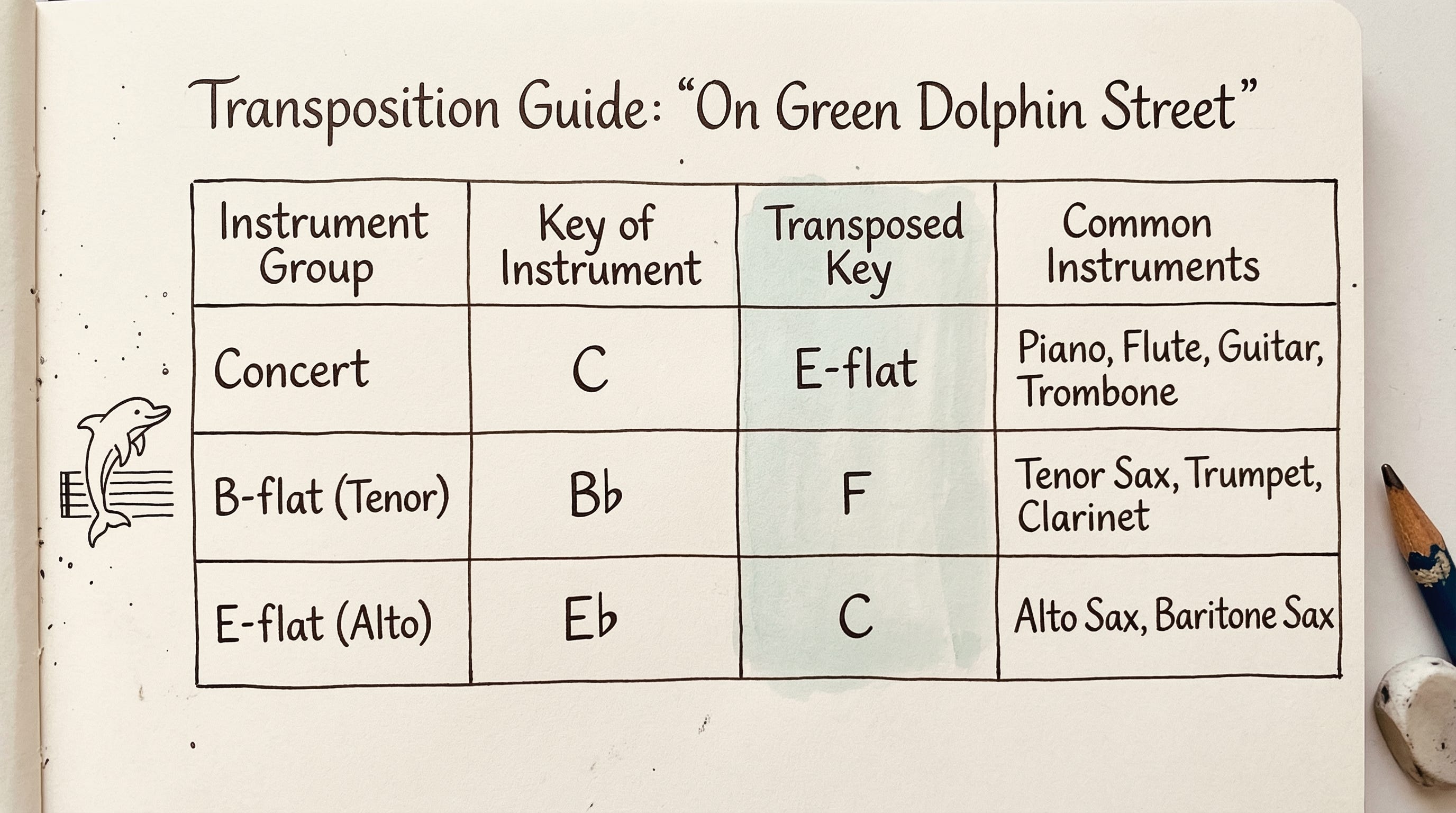
Old-timers like Ben Webster and Art Tatum used key changes as “weapons of war” and used to challenge newcomers at jam sessions by calling a tune in an obscure key — certainly not what we would today call the “Real Book” key, or the most common rendering. When it comes to vocalists, all bets are off; you could be playing in any key depending on the singer’s range. For a horn player, the key makes all the difference. I don’t know why, but “On Green Dolphin Street” sounds hipper in E flat than it does in C. Miles Davis, who played it in E flat, always had a knack for selecting the “right” key.
For a long time, playing in all keys was a daunting and frustrating experience. If I was learning a song from a lead sheet, that was hard enough. You can listen and learn from a recording or memorize it from the book — I combine both methods. Once you learn a song, if you can’t play it in all keys, you are essentially hamstrung. It is a definite shortcoming and a vulnerability. You could be on the stand, get a song you feel you know well, and then be totally tripped up.
That happened to me too often. Over the years, I have felt compelled — no matter how mistake-ridden or repetitive — to learn my repertoire in at least three keys. That’s the minimum baseline if you want to play tenor, soprano or clarinet; alto or baritone; and piano or flute. A tenor sax is a B flat instrument, meaning when a tenor player sees a “C,” it sounds like a B flat a major second below. To play a concert C song, the tenor player must play in D. Realistically, this is what a professional would be called on to know.
The approach
There are two ways I approach different keys. The first is playing by ear. In a lesson with pianist Pete Malinverni, Pete played some notes and asked me to play them back. I more or less did, and he said “Pretty good.”
It often feels like you are guessing, and you really are. The fact that some people with perfect pitch or other extraordinary sensory talents can do this the first time separates them from mere mortals, but that doesn’t mean we shouldn’t keep trying. Eventually, you will be able to patch the song together with confidence.
Start with songs you know backwards and forwards. I find “Happy Birthday” useful because you will always need it on a gig and you never know which key will be called. It is elegant but has a couple of tricky intervals. Other songs with relatively simple patterns are good for practice, such as “Sunny,” “Route 66,” or “Mack the Knife.” Performers who do these songs usually modulate from one key to the next because their simplicity lends itself to this kind of memorization.
You may want to learn a bebop song like Bird’s “Confirmation” or “Anthropology” in 12 keys, but you aren’t going to get there right away — you’ll be flailing through accidentals, flat fives, and leaps that don’t always fit the pattern. So many notes.
When that happens, I turn to the second approach: memorizing the numerical value of the note and the interval to the next. Some intervals are unpredictable. Songs like “The Shadow of Your Smile” or “Invitation” show surprising leaps.
Lazy River
I’ve been spending a lot of time learning the chestnut“(Up a) Lazy River” in all 12 keys. With music by clarinetist Sidney Arodin and lyrics by Hoagy Carmichael, the song describes the riverboat run, “bird’s songs” and blue skies. First recorded by Carmichael’s orchestra in 1930, I love the big octave leap at the start of the song and the semi-chromatic runs later on. It’s usually played as a soft, supple lullaby, but Carmichael said in interviews that “it should have been sung up tempo and with some guts.”
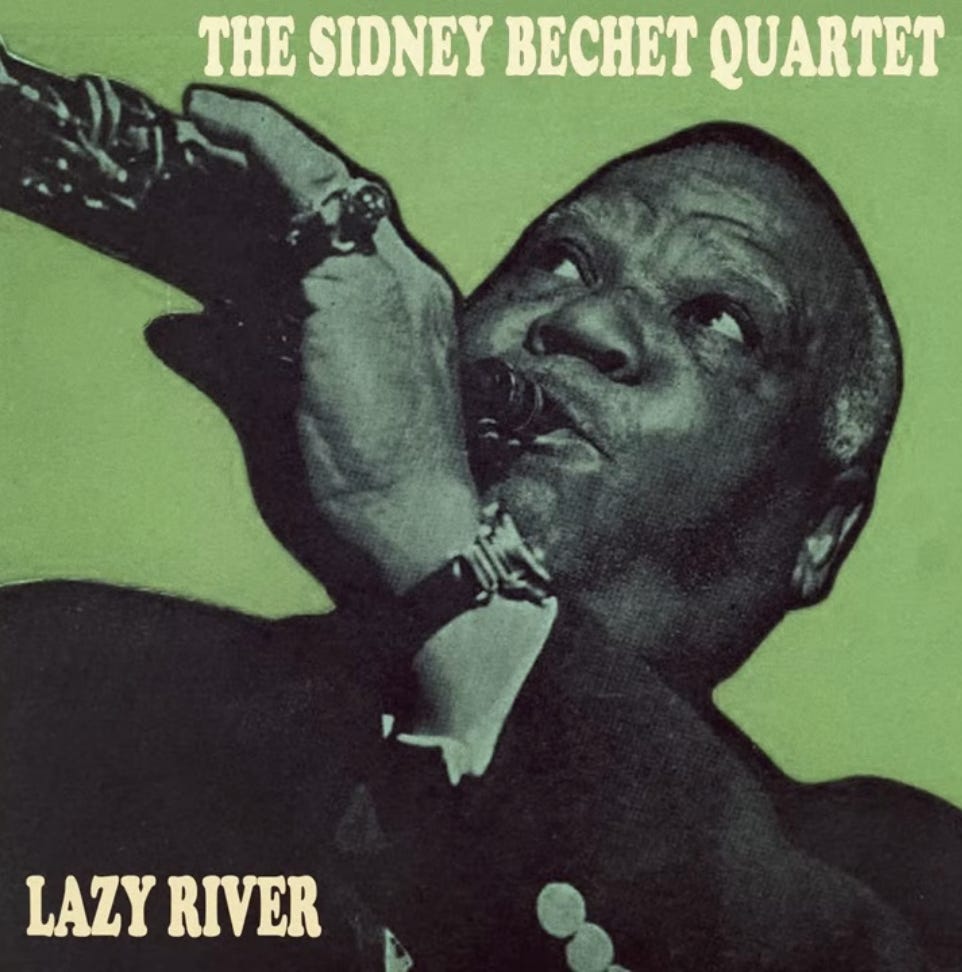
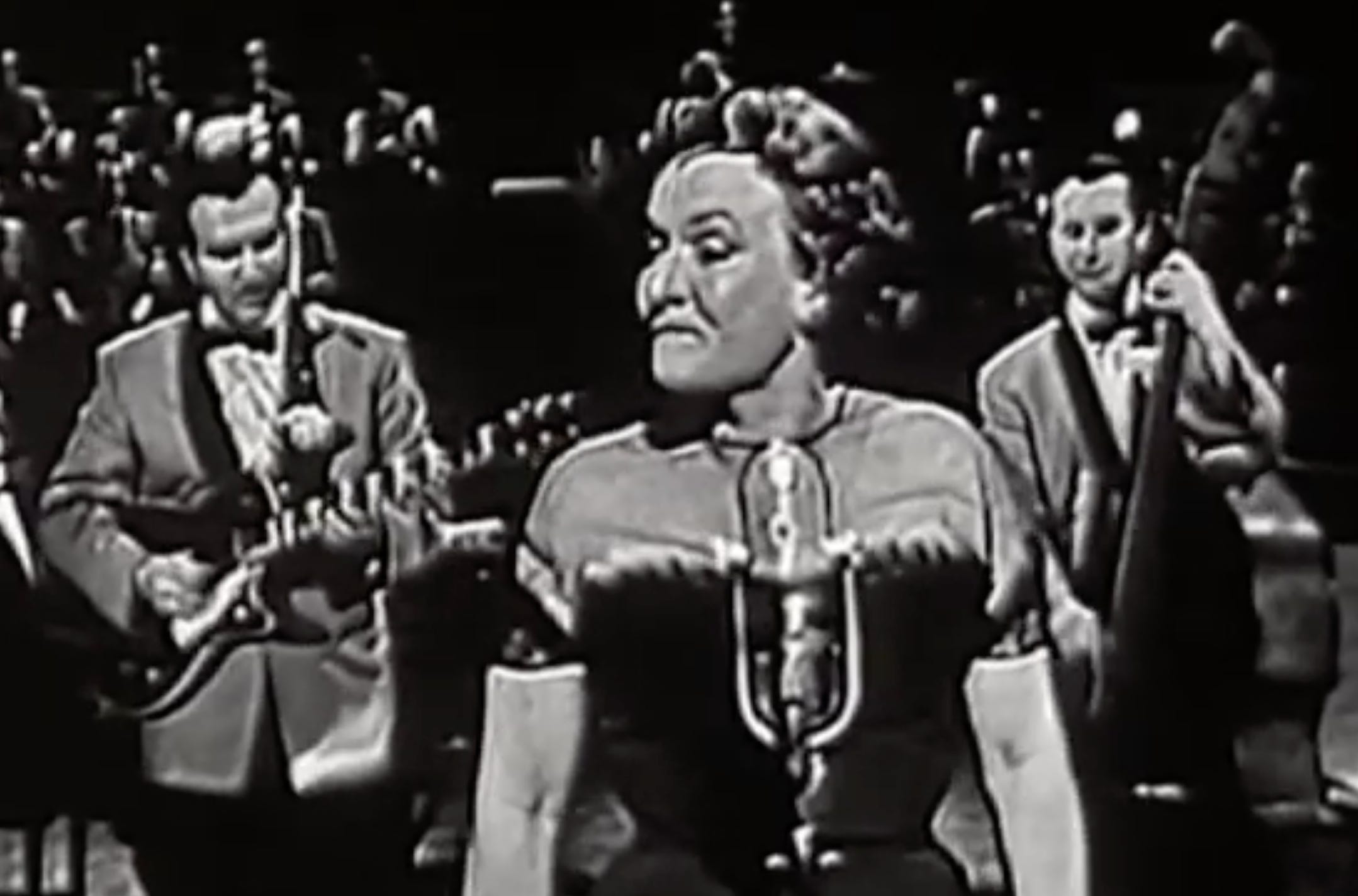
I like Sidney Bechet’s version, which in my mind has plenty of “guts.” He praised the version by Roberta Sherwood (seen at top with the Mills Bros.), a lesser known jazz singer. Her rendition of “Lazy River” hit No. 57 on the Hot 100 in 1956.
If you think of the first note as 1, the next as a specific interval, and so on — pretty soon you’ll begin to notice the same patterns in other tunes. Don’t take on too much at once. Pace it.
Do the first couple of bars today, the next phrase tomorrow. Master the bridge once you’ve got the A section down. You’ll be able to combine your listening and measuring intervals to bring together more complicated phrases. Eventually you drop the middle step — translation — and just play.
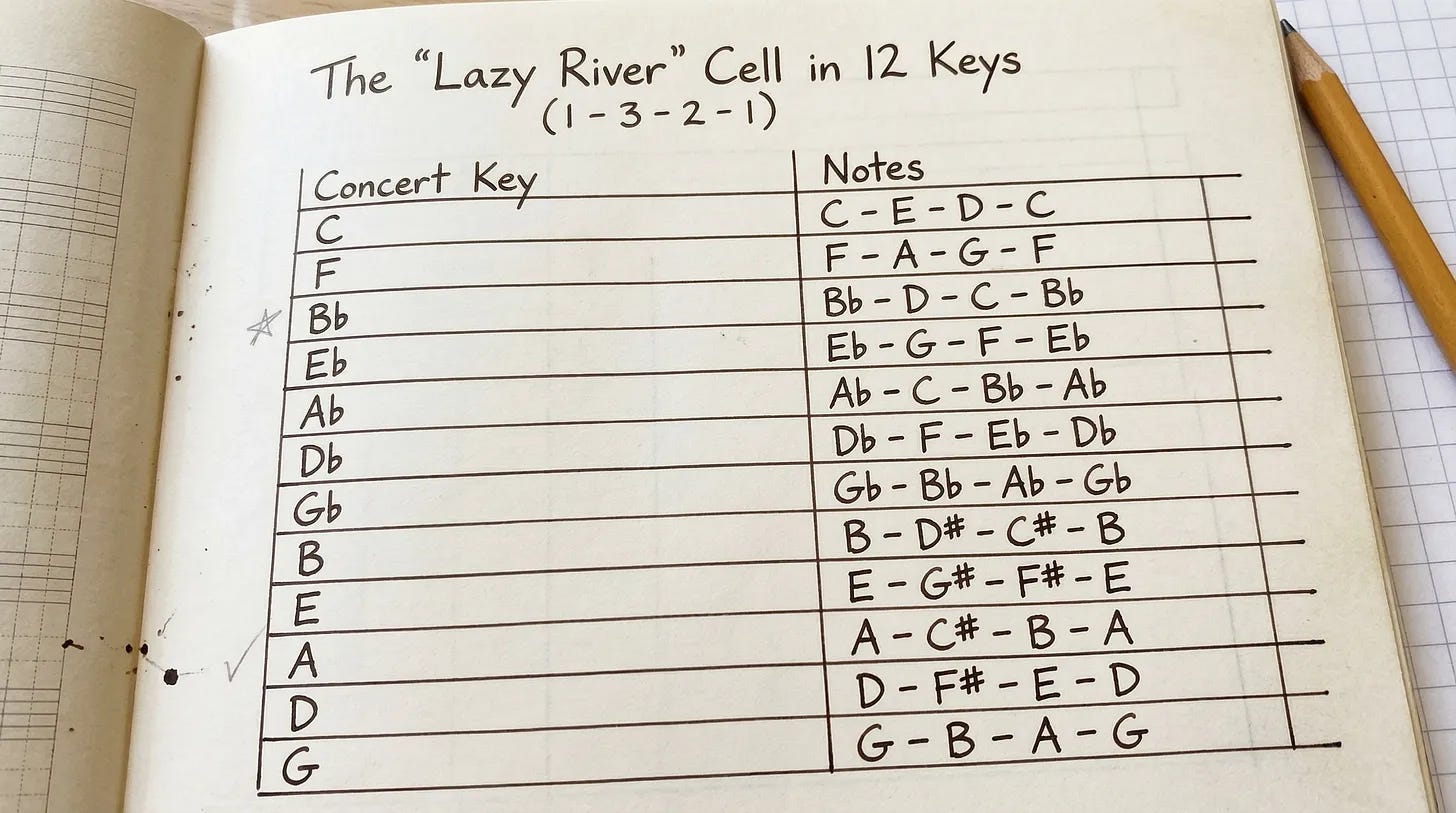
Start with four notes; some people might call them a “cell.” Just playing those first four notes in all keys is a pleasant exercise. Again. “Lazy River”… Again. “Lazy River.” Again. Just do not do this with company in the house. “Lazy River.”
And if you want to be hip, consider a couple bars of “Giant Steps.” It’s just notes. Although when you’re trying to learn lines from players like Bird, Dexter or Sonny who have these long developed melodic lines, it’s even harder — at first. I like to think the definition of learning something is to do it until it isn’t hard anymore.
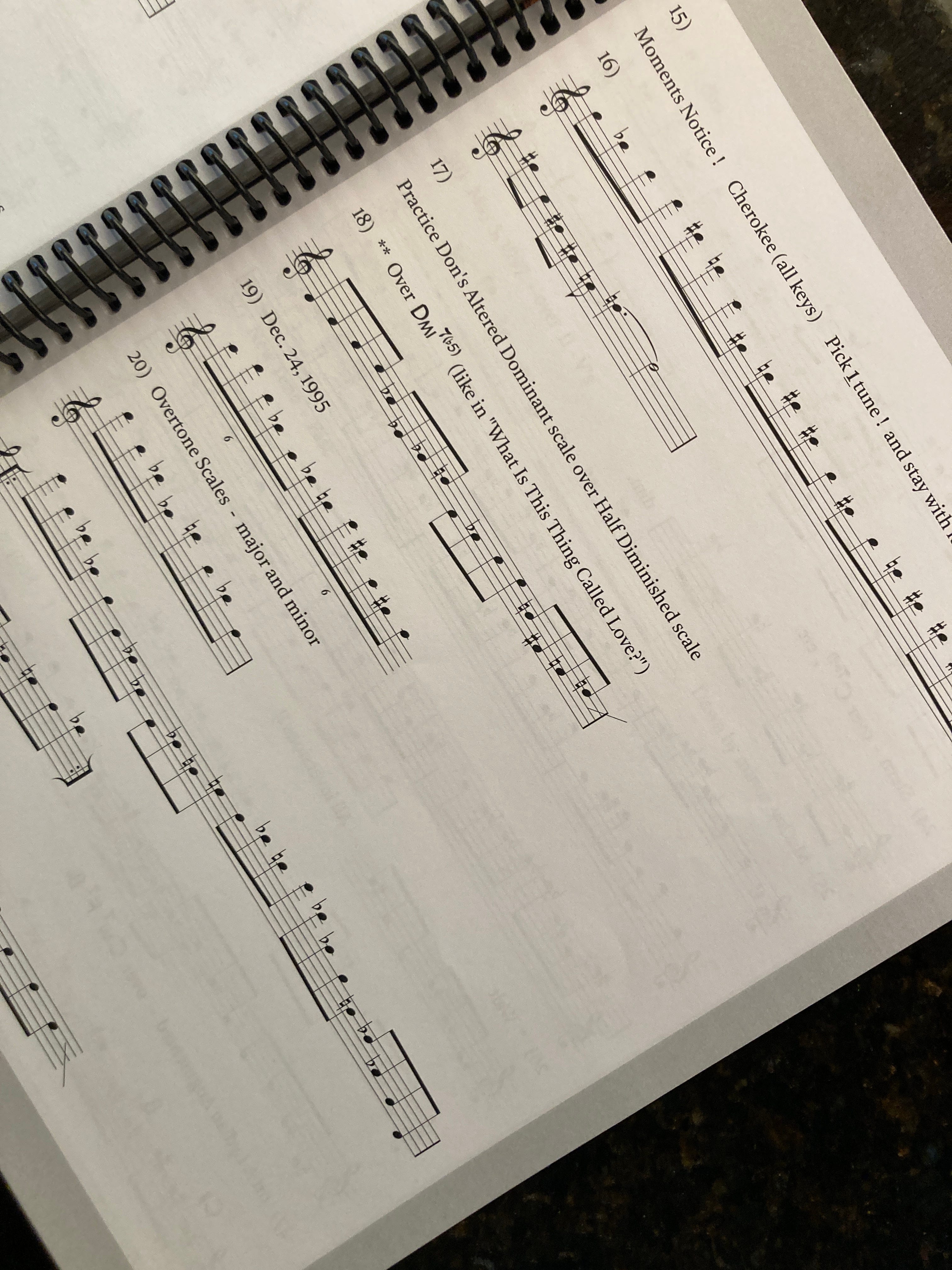
In the intriguing “Practice Notebooks of Michael Brecker,” publisher Chuck Sher said Brecker would take one of Sonny Rollins’ licks and play it over and over and over until it sounded absolutely smooth, fresh, swinging, relaxed and of course like Sonny... Then he would take the original lick and move it around to a bunch of other keys.
At the end of it when the band leader calls for any jazz standard — in any key — you’ll be ready to make more than a stumbling stab at it.
Thanks for this RJ, very interesting discussion and some of my favorite tunes. Now I want to know what you advised or told Kit!
How would a singer approach this challenge, RJ? We so often just "harmonize" without knowing where we are on the keyboard! I'm no longer doing much singing publicly nor planning to, but I'm guessing a singer might just "do it by ear". Interesting to ponder.